
Mona Awad’s Ivy League horror novel, Bunny (2019).
03 02 22; 3 days pre-salon
“I want this to be akin to Bennington College 1980s Donna-Tartt-hosted party,” I tell my friends over text. My order of culinary lavender arrived a few days ago, and the scent lingers prettily in my nose whenever I take in its scent. For this book event I will fix up some lavender muffins, as an ode to one of the Bunnies in Bunny, Cupcake. Our book of the month is Bunny by Mona Awad, a novel set at a fictional Ivy League university in a small, all-women MFA program. There’s a clique that consumes everyone but our main character Samantha, called the Bunnies. They refer to each other exclusively as “Bunny” as a term of endearment, but the shrillness and chaotic nature of their superorganism transcends typical cliquey gossip. The Bunnies hold a weekly ‘Smut Salon,’ in which perverse fantasies come alive through the vessel of a bunny, freshly murdered and transfigured into a male-appearing creation. A hybrid of the Bunnies’ sexual desires materialized as a man and a bunny. Their hands are often wrapped in leather gloves, because their magic cannot seem to get that part right. These “hybrids” or “drafts” make it into the world sometimes, or fall under the axe of a pretty girl in pink.
One day, Samantha, our lovely outcast, is invited. The book ascends with wild momentum. It is the kind of novel that magnetizes you to its story. Awad’s writing style is rhythmic, unique, and hilarious. And I am so jazzed to talk to twenty friends or so about this book on Friday.
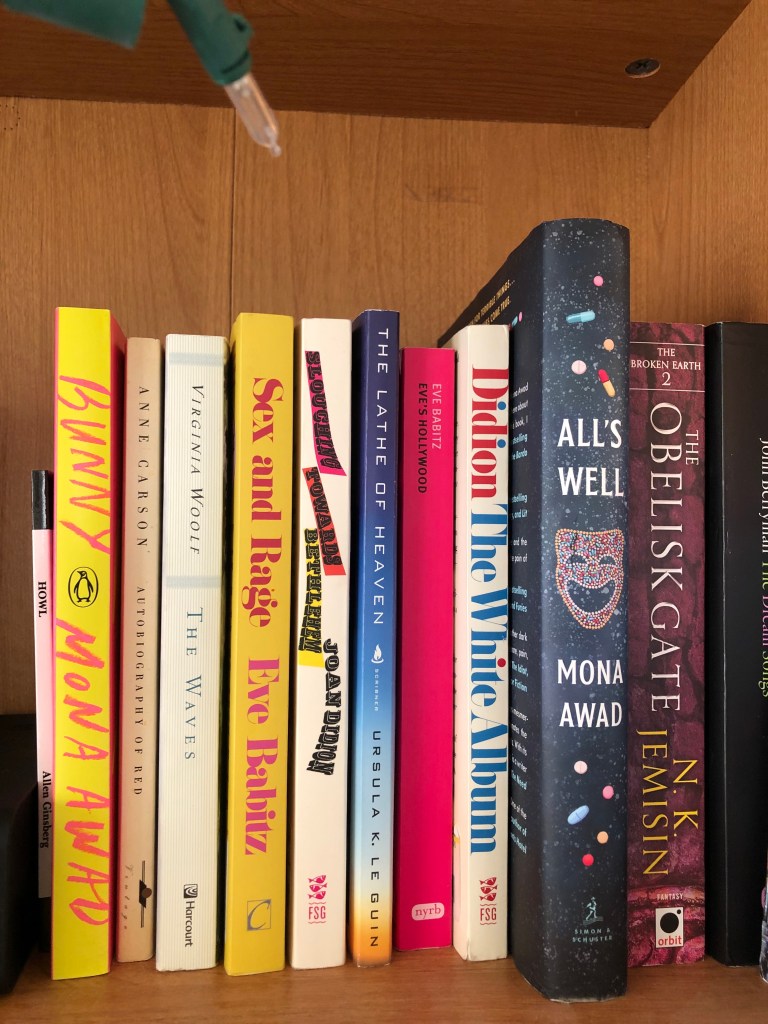
With baked goods and stellar minds, we delved into the novel. Bunny punch, a fruity tequila drink, in red cups in our hands as we viciously gesticulate about our thoughts on the book. Different editions of the novel scattered about the floor, hot pink, autumnal orange, a black hardcover borrowed from Harvard’s library. I’ve never been in a book club, and now my friend Sophia and I are running one, and it is a jagged, frenetic atmosphere with sugar and drink and every seat taken in a circle around the room.
Sophia and I decided to forego structure and see the natural discussion of the book, but soon we were telling stories of our high school crushes, one by one. The conversation circled back to the book every now and then. Mona Awad received less critical acclaim than I expected; for such an original novel with a biting writing voice, I believed that we would all fawn over her upended Ivy League world. Instead, we expanded the space into a feminist questioning ground, and the conversation blossomed.
The question of internalized misogony is a finicky one. It is defined as when women subconsciously project sexist ideas onto other women and even onto themselves. For example “I’m not like THOSE girls…”
Is the trope of the outsider character a good idea when the character’s thoughts are nefarious ones about the clique of women? Paired with the narrator Samatha’s unwavering misery, it seemed to many members that Awad was a strangely jealous, insecure, stuck-up writer. Some did research prior to the club and ascertained that the novel was based on Awad’s experience at Brown University’s experimental MFA program in 2014. One member even said that they read about the members of her MFA cohort reacting to Bunny, completely weirded out and offended. As absurd and fantastical as the novel may be, there is definitely autofiction embroidered into the plot.
A less literary parallel to an example of internalized misogyny in art is the song Misery Business by Paramore, in which the Hayley Williams calls her boyfriend’s ex a whore, saying that there are a million girls just like her, looking innocent to get she wants. Paramore stopped playing that song live because Williams was eighteen when she wrote it in 2007, and she grew from the unfeminist writing. The way that Awad paints the Bunnies is rife with hilarious, yet insulting remarks.
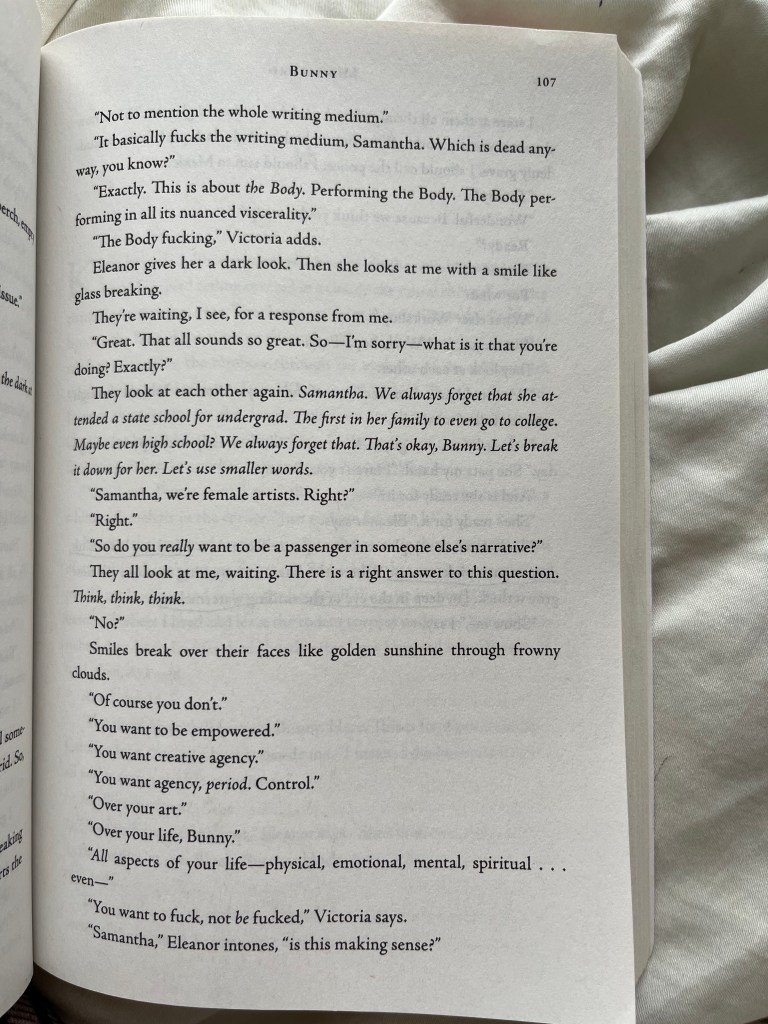
In this passage, she writes feminist sentiments into the Bunnies’ dialogue after deeming them frivolous, childlike, needy, and overly “girly” in the sense of everything they own is pink. The issue arises when it takes certain values of feminism and becomes hard to distinguish if she is satirizing or mocking them.
In an egalitarian circle, two people assumed the form of leading, partially because they are big personalities and because we didn’t plan any structure to the discussion. Our plan for serendipity ended up becoming a bit of a heated conversation. The smell of a sugary, fruity drink wafter from my friend’s cup next to me. The cloyed baby-pink nightmare clique of the Bunnies was not only an exaggeration of femininity through the lens of jealousy but overly villainized rather harmless MFA students.
Oftentimes women, LGBTQ+, and PoC writers get pigeonholed because they’re writing about that experience as if books have to be promoting their identity – or when it comes to women in writing, the idea that women must be inherently feminist writers bc of who they are; there’s a problem because that is a strict identity-based lens. What we felt a bit weird was that a woman wrote a book when it’s clear that the antagonists that are also women that aren’t evil for any other reason for what they like – some thought the Bunnies were not convincing villains. Awad’s claim that because they are cliquey and like glitter and rainbows and oh are the worst writers and people on the planet for this.
Regardless of our analytical, critical, ginormous discussion, Mona Awad’s writing style is still something to admire. “I look down at my phone. No response from Ava. I feel my heart sink deeper into pink waters. Where the haze was starting to clear, it’s now grown thick. I’m deep in the eye of the smiling watermelon.”
She describes the dainty Bunnies fastidiously, for example, one girl’s “pearled throat of soft blue.” Her usage of short, sharp sentences pulses like my very own torrent of thoughts. The unreliable narrator ensnares us in her mental undoings along with her throughout the book. Firstly, her admittance to the clique and subsequent hive mind language of “we” instead of “I”, and the unreality of her drunken, drugged, and shock states. This is dreamlike yet still coherent, pushing the reader’s suspension of belief farther and farther.
As friends clutching the hot pink book trickled out, some stayed with the stillness only known to the over-comsumption of sweets. I packed the remaining cupcakes for myself, and walked home, a feeling of freshness within me. My first book club! A wide turnout and a critically gorgeous discussion.
 Pussy and Paperbacks
Leave a comment