

-
While the horizon is still glowing orange I walk to the small grocer down the street. I listen to what people are saying as they pass by or what expressions they have across their faces. What is that face of half-greeting? How can I describe that? Can I remember the person saying “I can do your makeup if you know what I mean,” so I can write it down later? There may be little significance to a line even if it is slightly bemusing, but there is a compulsion for me to write it down, render it real, in ink.
– (01/25/2022, Ithaca, NY)
This compulsion of mine arises out of reading about how Joan Didion perceives the notebook for a writer, as well as the reasons for writing in general. Her curiosity glimmers and assuages my restlessness during this time because I can accompany her through her writings. She describes California with a critical vivacity; there are so many things that the writer’s eye sees that perhaps the non-writer eye does not automatically acknowledge.
Didion shows in her essay “On Keeping a Notebook” that there is a certain wiring to a writer’s brain, which is why I make that distinction, because I have that peculiar wiring too. In creative writing classes I am said to add a profusion of details, which if trimmed, could provide for a more effective, streamlined story. But in my Murakami-esque, obsessive haze, I simply must describe what touches me. Didion admits the same thing, and with that utilizes grammar to its fullest power.
Reading Joan Didion as a young woman cements some type of earnestness into one’s voice. There is an indelible cadence to her writing: flourishing yet sharp. She speaks with a pure and bright conviction even when touching upon her own shortcomings. This is what makes her work dazzle. She writes with full self-awareness, even if it seems unglamorous to talk about one’s capricious moods. As a journalist, novelist, memoirist, and sublime human being, Joan Didion does not smear a gloss over the truth, nor wreck anything more than it is already wrecked. Her writing is so genuine, so meticulously crafted, that reading her brings one to a state of hypersensitivity. Her infinite state of observing is contagious, but why does this matter for anyone?
After her death on December 23rd, 2021, there was a profusion of obituaries and wonderful long-form pieces published online. I read over forty articles dutifully, collecting all the details about her life that I could outside of her books. Writers like Zadie Smith crafted beautiful features, praising how she wielded language, yet also facing bluntly how her ideas about the feminist movement were somewhat distasteful. Smith, however, explains that regardless of whether or not she thought of herself as being a part of the women’s movement, she still lit a future for women writers that is still burning bright red.

Zadie Smith, 2021 “With notable exceptions, Didion was a woman who did not so much express opinions, or emotions, as interrogate both.”
What I still have not found within the words of these articles is the idea of stature. The perception of petiteness. The feminist triumph she made throughout all of her days, by simply getting on the phone and arriving at a place to report. Of course, she has been praised for such things, but not in the specifics of being a small, yet wildly intelligent iconoclast.
Joan Didion was five feet tall. I am five foot one. How is this important in the realm of writing? I find that as a small person, it is rare to be taken entirely seriously. Having to tilt your neck down towards me automatically renders you a person of power, in the sense of stature.
She writes:
“My only advantage as a reporter is that I am so physically small, so temperamentally unobstrusive, and so neurotically inarticulate that people tend to forget that my presence runs counter to their best interests. And it always does.”
from Slouching Towards Bethlehem, 1968
Where I may find some bit of hopelessness, Didion, writing through her thought process, found a surreptitious place of potential. The ability to remain demure whilst being small made her privy to information that might have been withheld around another figure. She speaks in an interview about the fact that she still is visibly reporting, with a notebook, tape recorder, making sure people know what she’s there for. Instead, she remarks that instead of being aggressive in her interview style, she “hangs around the edges,” seeing what is going on, letting the interview unravel. People do not perceive her as a threat, even though what she could subsequently write could show corruption, or other interesting things.
This is an angle quite unique to her lived experience. As a young writer, she gives me a vivid hope, to be an authoritative, interrogative, and thoughtful writer. I wear two to four-inch platforms every time I leave the house, and she was photographed usually wearing flip-flops. When I enter someone’s house for the first time and dismount from my high boots, I am immediately called “so short!” or “so cute!” I don’t want to be cute; there’s something juvenile about that word in the context of height. I want to be taken seriously as Didion was. This has led me to putting my writing on websites and sharing it.
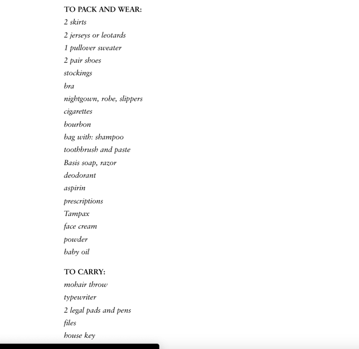
Packing list from The White Album , 1979 If someone has not read anything by Joan Didion, it can be daunting to begin. In March 2017, I purchased a copy of Democracy, and today cannot remember much besides the electric blue water I pictured as she described Hawaii. However, her writings about when she lived there are far more compelling. As a woman who said that she did not keep a diary (in an interview with Andy Warhol), there is a diaristic bareness to her writings on Hawaii, and the brilliant sarcasm of a place that is referred to as “paradise.”
“Because I had been tired too long and quarrelsome too much and too often frightened of migraine and failure and the days getting shorter, I was sent, a recalcitrant thirty-one-year-old child, to Hawaii, where winter does not come and no one fails and the median age is twenty-three. There I could become a new woman..”
Letter from Paradise, 21º 19’ N., 157º 52’ W., Slouching Towards Bethlehem.
In our current cultural bedlam, it is essential to read her work. There is a similar urgency to finding answers about why things are the way that they are. A piece from the late 1960s or the early 1970s threads through to today, where unearthing the truth is even harder. Joan Didion’s writing imbues the reader with urgency; now that our eyes are wide-open (hopefully under sunglasses as big as her’s!) it is impossible to ignore the inconsistencies of messages. Get reading, get writing, Didion tells us. It’s not the pre-internet age, but it is the same neon message.

Joan Didion at the Whisky A-Go-Go, Credit to Netflix Now that she has passed on, we are left with some of the richest writings of an American author. She fused the journalistic with the personal, crafting a unique picture that showed a woman who lived in this country, and the thoughts that passed through her mind. Readers everywhere can still experience the magic of her unique writing, carrying on her curiosity forever.
-
While the horizon is still glowing orange I walk to the small grocer down the street. I listen to what people are saying as they pass by or what expressions they have across their faces. What is that face of half-greeting? How can I describe that? Can I remember the person saying “I can do your makeup if you know what I mean,” so I can write it down later? There may be little significance to a line even if it is slightly bemusing, but there is a compulsion for me to write it down, render it real, in ink.
– (01/25/2022, Ithaca, NY)
This compulsion of mine arises out of reading about how Joan Didion perceives the notebook for a writer, as well as the reasons for writing in general. Her curiosity glimmers and assuages my restlessness during this time because I can accompany her through her writings. She describes California with a critical vivacity; there are so many things that the writer’s eye sees that perhaps the non-writer eye does not automatically acknowledge.
Didion shows in her essay “On Keeping a Notebook” that there is a certain wiring to a writer’s brain, which is why I make that distinction, because I have that peculiar wiring too. In creative writing classes I am said to add a profusion of details, which if trimmed, could provide for a more effective, streamlined story. But in my Murakami-esque, obsessive haze, I simply must describe what touches me. Didion admits the same thing, and with that utilizes grammar to its fullest power.
Reading Joan Didion as a young woman cements some type of earnestness into one’s voice. There is an indelible cadence to her writing: flourishing yet sharp. She speaks with a pure and bright conviction even when touching upon her own shortcomings. This is what makes her work dazzle. She writes with full self-awareness, even if it seems unglamorous to talk about one’s capricious moods. As a journalist, novelist, memoirist, and sublime human being, Joan Didion does not smear a gloss over the truth, nor wreck anything more than it is already wrecked. Her writing is so genuine, so meticulously crafted, that reading her brings one to a state of hypersensitivity. Her infinite state of observing is contagious, but why does this matter for anyone?
After her death on December 23rd, 2021, there was a profusion of obituaries and wonderful long-form pieces published online. I read over forty articles dutifully, collecting all the details about her life that I could outside of her books. Writers like Zadie Smith crafted beautiful features, praising how she wielded language, yet also facing bluntly how her ideas about the feminist movement were somewhat distasteful. Smith, however, explains that regardless of whether or not she thought of herself as being a part of the women’s movement, she still lit a future for women writers that is still burning bright red.
Zadie Smith, 2021 “With notable exceptions, Didion was a woman who did not so much express opinions, or emotions, as interrogate both.”
What I still have not found within the words of these articles is the idea of stature. The perception of petiteness. The feminist triumph she made throughout all of her days, by simply getting on the phone and arriving at a place to report. Of course, she has been praised for such things, but not in the specifics of being a small, yet wildly intelligent iconoclast.
Joan Didion was five feet tall. I am five foot one. How is this important in the realm of writing? I find that as a small person, it is rare to be taken entirely seriously. Having to tilt your neck down towards me automatically renders you a person of power, in the sense of stature.
She writes:
“My only advantage as a reporter is that I am so physically small, so temperamentally unobstrusive, and so neurotically inarticulate that people tend to forget that my presence runs counter to their best interests. And it always does.”
from Slouching Towards Bethlehem, 1968
Where I may find some bit of hopelessness, Didion, writing through her thought process, found a surreptitious place of potential. The ability to remain demure whilst being small made her privy to information that might have been withheld around another figure. She speaks in an interview about the fact that she still is visibly reporting, with a notebook, tape recorder, making sure people know what she’s there for. Instead, she remarks that instead of being aggressive in her interview style, she “hangs around the edges,” seeing what is going on, letting the interview unravel. People do not perceive her as a threat, even though what she could subsequently write could show corruption, or other interesting things.
This is an angle quite unique to her lived experience. As a young writer, she gives me a vivid hope, to be an authoritative, interrogative, and thoughtful writer. I wear two to four-inch platforms every time I leave the house, and she was photographed usually wearing flip-flops. When I enter someone’s house for the first time and dismount from my high boots, I am immediately called “so short!” or “so cute!” I don’t want to be cute; there’s something juvenile about that word in the context of height. I want to be taken seriously as Didion was. This has led me to putting my writing on websites and sharing it.
Packing list from The White Album , 1979 If someone has not read anything by Joan Didion, it can be daunting to begin. In March 2017, I purchased a copy of Democracy, and today cannot remember much besides the electric blue water I pictured as she described Hawaii. However, her writings about when she lived there are far more compelling. As a woman who said that she did not keep a diary (in an interview with Andy Warhol), there is a diaristic bareness to her writings on Hawaii, and the brilliant sarcasm of a place that is referred to as “paradise.”
“Because I had been tired too long and quarrelsome too much and too often frightened of migraine and failure and the days getting shorter, I was sent, a recalcitrant thirty-one-year-old child, to Hawaii, where winter does not come and no one fails and the median age is twenty-three. There I could become a new woman..”
Letter from Paradise, 21º 19’ N., 157º 52’ W., Slouching Towards Bethlehem.
In our current cultural bedlam, it is essential to read her work. There is a similar urgency to finding answers about why things are the way that they are. A piece from the late 1960s or the early 1970s threads through to today, where unearthing the truth is even harder. Joan Didion’s writing imbues the reader with urgency; now that our eyes are wide-open (hopefully under sunglasses as big as her’s!) it is impossible to ignore the inconsistencies of messages. Get reading, get writing, Didion tells us. It’s not the pre-internet age, but it is the same neon message.
Joan Didion at the Whisky A-Go-Go, Credit to Netflix Now that she has passed on, we are left with some of the richest writings of an American author. She fused the journalistic with the personal, crafting a unique picture that showed a woman who lived in this country, and the thoughts that passed through her mind. Readers everywhere can still experience the magic of her unique writing, carrying on her curiosity forever.
-
While the horizon is still glowing orange I walk to the small grocer down the street. I listen to what people are saying as they pass by or what expressions they have across their faces. What is that face of half-greeting? How can I describe that? Can I remember the person saying “I can do your makeup if you know what I mean,” so I can write it down later? There may be little significance to a line even if it is slightly bemusing, but there is a compulsion for me to write it down, render it real, in ink.
– (01/25/2022, Ithaca, NY)
This compulsion of mine arises out of reading about how Joan Didion perceives the notebook for a writer, as well as the reasons for writing in general. Her curiosity glimmers and assuages my restlessness during this time because I can accompany her through her writings. She describes California with a critical vivacity; there are so many things that the writer’s eye sees that perhaps the non-writer eye does not automatically acknowledge.
Didion shows in her essay “On Keeping a Notebook” that there is a certain wiring to a writer’s brain, which is why I make that distinction, because I have that peculiar wiring too. In creative writing classes I am said to add a profusion of details, which if trimmed, could provide for a more effective, streamlined story. But in my Murakami-esque, obsessive haze, I simply must describe what touches me. Didion admits the same thing, and with that utilizes grammar to its fullest power.
Reading Joan Didion as a young woman cements some type of earnestness into one’s voice. There is an indelible cadence to her writing: flourishing yet sharp. She speaks with a pure and bright conviction even when touching upon her own shortcomings. This is what makes her work dazzle. She writes with full self-awareness, even if it seems unglamorous to talk about one’s capricious moods. As a journalist, novelist, memoirist, and sublime human being, Joan Didion does not smear a gloss over the truth, nor wreck anything more than it is already wrecked. Her writing is so genuine, so meticulously crafted, that reading her brings one to a state of hypersensitivity. Her infinite state of observing is contagious, but why does this matter for anyone?
After her death on December 23rd, 2021, there was a profusion of obituaries and wonderful long-form pieces published online. I read over forty articles dutifully, collecting all the details about her life that I could outside of her books. Writers like Zadie Smith crafted beautiful features, praising how she wielded language, yet also facing bluntly how her ideas about the feminist movement were somewhat distasteful. Smith, however, explains that regardless of whether or not she thought of herself as being a part of the women’s movement, she still lit a future for women writers that is still burning bright red.
Zadie Smith, 2021 “With notable exceptions, Didion was a woman who did not so much express opinions, or emotions, as interrogate both.”
What I still have not found within the words of these articles is the idea of stature. The perception of petiteness. The feminist triumph she made throughout all of her days, by simply getting on the phone and arriving at a place to report. Of course, she has been praised for such things, but not in the specifics of being a small, yet wildly intelligent iconoclast.
Joan Didion was five feet tall. I am five foot one. How is this important in the realm of writing? I find that as a small person, it is rare to be taken entirely seriously. Having to tilt your neck down towards me automatically renders you a person of power, in the sense of stature.
She writes:
“My only advantage as a reporter is that I am so physically small, so temperamentally unobstrusive, and so neurotically inarticulate that people tend to forget that my presence runs counter to their best interests. And it always does.”
from Slouching Towards Bethlehem, 1968
Where I may find some bit of hopelessness, Didion, writing through her thought process, found a surreptitious place of potential. The ability to remain demure whilst being small made her privy to information that might have been withheld around another figure. She speaks in an interview about the fact that she still is visibly reporting, with a notebook, tape recorder, making sure people know what she’s there for. Instead, she remarks that instead of being aggressive in her interview style, she “hangs around the edges,” seeing what is going on, letting the interview unravel. People do not perceive her as a threat, even though what she could subsequently write could show corruption, or other interesting things.
This is an angle quite unique to her lived experience. As a young writer, she gives me a vivid hope, to be an authoritative, interrogative, and thoughtful writer. I wear two to four-inch platforms every time I leave the house, and she was photographed usually wearing flip-flops. When I enter someone’s house for the first time and dismount from my high boots, I am immediately called “so short!” or “so cute!” I don’t want to be cute; there’s something juvenile about that word in the context of height. I want to be taken seriously as Didion was. This has led me to putting my writing on websites and sharing it.
Packing list from The White Album , 1979 If someone has not read anything by Joan Didion, it can be daunting to begin. In March 2017, I purchased a copy of Democracy, and today cannot remember much besides the electric blue water I pictured as she described Hawaii. However, her writings about when she lived there are far more compelling. As a woman who said that she did not keep a diary (in an interview with Andy Warhol), there is a diaristic bareness to her writings on Hawaii, and the brilliant sarcasm of a place that is referred to as “paradise.”
“Because I had been tired too long and quarrelsome too much and too often frightened of migraine and failure and the days getting shorter, I was sent, a recalcitrant thirty-one-year-old child, to Hawaii, where winter does not come and no one fails and the median age is twenty-three. There I could become a new woman..”
Letter from Paradise, 21º 19’ N., 157º 52’ W., Slouching Towards Bethlehem.
In our current cultural bedlam, it is essential to read her work. There is a similar urgency to finding answers about why things are the way that they are. A piece from the late 1960s or the early 1970s threads through to today, where unearthing the truth is even harder. Joan Didion’s writing imbues the reader with urgency; now that our eyes are wide-open (hopefully under sunglasses as big as her’s!) it is impossible to ignore the inconsistencies of messages. Get reading, get writing, Didion tells us. It’s not the pre-internet age, but it is the same neon message.
Joan Didion at the Whisky A-Go-Go, Credit to Netflix Now that she has passed on, we are left with some of the richest writings of an American author. She fused the journalistic with the personal, crafting a unique picture that showed a woman who lived in this country, and the thoughts that passed through her mind. Readers everywhere can still experience the magic of her unique writing, carrying on her curiosity forever.
-
While the horizon is still glowing orange I walk to the small grocer down the street. I listen to what people are saying as they pass by or what expressions they have across their faces. What is that face of half-greeting? How can I describe that? Can I remember the person saying “I can do your makeup if you know what I mean,” so I can write it down later? There may be little significance to a line even if it is slightly bemusing, but there is a compulsion for me to write it down, render it real, in ink.
– (01/25/2022, Ithaca, NY)
This compulsion of mine arises out of reading about how Joan Didion perceives the notebook for a writer, as well as the reasons for writing in general. Her curiosity glimmers and assuages my restlessness during this time because I can accompany her through her writings. She describes California with a critical vivacity; there are so many things that the writer’s eye sees that perhaps the non-writer eye does not automatically acknowledge.
Didion shows in her essay “On Keeping a Notebook” that there is a certain wiring to a writer’s brain, which is why I make that distinction, because I have that peculiar wiring too. In creative writing classes I am said to add a profusion of details, which if trimmed, could provide for a more effective, streamlined story. But in my Murakami-esque, obsessive haze, I simply must describe what touches me. Didion admits the same thing, and with that utilizes grammar to its fullest power.
Reading Joan Didion as a young woman cements some type of earnestness into one’s voice. There is an indelible cadence to her writing: flourishing yet sharp. She speaks with a pure and bright conviction even when touching upon her own shortcomings. This is what makes her work dazzle. She writes with full self-awareness, even if it seems unglamorous to talk about one’s capricious moods. As a journalist, novelist, memoirist, and sublime human being, Joan Didion does not smear a gloss over the truth, nor wreck anything more than it is already wrecked. Her writing is so genuine, so meticulously crafted, that reading her brings one to a state of hypersensitivity. Her infinite state of observing is contagious, but why does this matter for anyone?
After her death on December 23rd, 2021, there was a profusion of obituaries and wonderful long-form pieces published online. I read over forty articles dutifully, collecting all the details about her life that I could outside of her books. Writers like Zadie Smith crafted beautiful features, praising how she wielded language, yet also facing bluntly how her ideas about the feminist movement were somewhat distasteful. Smith, however, explains that regardless of whether or not she thought of herself as being a part of the women’s movement, she still lit a future for women writers that is still burning bright red.
Zadie Smith, 2021 “With notable exceptions, Didion was a woman who did not so much express opinions, or emotions, as interrogate both.”
What I still have not found within the words of these articles is the idea of stature. The perception of petiteness. The feminist triumph she made throughout all of her days, by simply getting on the phone and arriving at a place to report. Of course, she has been praised for such things, but not in the specifics of being a small, yet wildly intelligent iconoclast.
Joan Didion was five feet tall. I am five foot one. How is this important in the realm of writing? I find that as a small person, it is rare to be taken entirely seriously. Having to tilt your neck down towards me automatically renders you a person of power, in the sense of stature.
She writes:
“My only advantage as a reporter is that I am so physically small, so temperamentally unobstrusive, and so neurotically inarticulate that people tend to forget that my presence runs counter to their best interests. And it always does.”
from Slouching Towards Bethlehem, 1968
Where I may find some bit of hopelessness, Didion, writing through her thought process, found a surreptitious place of potential. The ability to remain demure whilst being small made her privy to information that might have been withheld around another figure. She speaks in an interview about the fact that she still is visibly reporting, with a notebook, tape recorder, making sure people know what she’s there for. Instead, she remarks that instead of being aggressive in her interview style, she “hangs around the edges,” seeing what is going on, letting the interview unravel. People do not perceive her as a threat, even though what she could subsequently write could show corruption, or other interesting things.
This is an angle quite unique to her lived experience. As a young writer, she gives me a vivid hope, to be an authoritative, interrogative, and thoughtful writer. I wear two to four-inch platforms every time I leave the house, and she was photographed usually wearing flip-flops. When I enter someone’s house for the first time and dismount from my high boots, I am immediately called “so short!” or “so cute!” I don’t want to be cute; there’s something juvenile about that word in the context of height. I want to be taken seriously as Didion was. This has led me to putting my writing on websites and sharing it.
Packing list from The White Album , 1979 If someone has not read anything by Joan Didion, it can be daunting to begin. In March 2017, I purchased a copy of Democracy, and today cannot remember much besides the electric blue water I pictured as she described Hawaii. However, her writings about when she lived there are far more compelling. As a woman who said that she did not keep a diary (in an interview with Andy Warhol), there is a diaristic bareness to her writings on Hawaii, and the brilliant sarcasm of a place that is referred to as “paradise.”
“Because I had been tired too long and quarrelsome too much and too often frightened of migraine and failure and the days getting shorter, I was sent, a recalcitrant thirty-one-year-old child, to Hawaii, where winter does not come and no one fails and the median age is twenty-three. There I could become a new woman..”
Letter from Paradise, 21º 19’ N., 157º 52’ W., Slouching Towards Bethlehem.
In our current cultural bedlam, it is essential to read her work. There is a similar urgency to finding answers about why things are the way that they are. A piece from the late 1960s or the early 1970s threads through to today, where unearthing the truth is even harder. Joan Didion’s writing imbues the reader with urgency; now that our eyes are wide-open (hopefully under sunglasses as big as her’s!) it is impossible to ignore the inconsistencies of messages. Get reading, get writing, Didion tells us. It’s not the pre-internet age, but it is the same neon message.
Joan Didion at the Whisky A-Go-Go, Credit to Netflix Now that she has passed on, we are left with some of the richest writings of an American author. She fused the journalistic with the personal, crafting a unique picture that showed a woman who lived in this country, and the thoughts that passed through her mind. Readers everywhere can still experience the magic of her unique writing, carrying on her curiosity forever.
-
While the horizon is still glowing orange I walk to the small grocer down the street. I listen to what people are saying as they pass by or what expressions they have across their faces. What is that face of half-greeting? How can I describe that? Can I remember the person saying “I can do your makeup if you know what I mean,” so I can write it down later? There may be little significance to a line even if it is slightly bemusing, but there is a compulsion for me to write it down, render it real, in ink.
– (01/25/2022, Ithaca, NY)
This compulsion of mine arises out of reading about how Joan Didion perceives the notebook for a writer, as well as the reasons for writing in general. Her curiosity glimmers and assuages my restlessness during this time because I can accompany her through her writings. She describes California with a critical vivacity; there are so many things that the writer’s eye sees that perhaps the non-writer eye does not automatically acknowledge.
Didion shows in her essay “On Keeping a Notebook” that there is a certain wiring to a writer’s brain, which is why I make that distinction, because I have that peculiar wiring too. In creative writing classes I am said to add a profusion of details, which if trimmed, could provide for a more effective, streamlined story. But in my Murakami-esque, obsessive haze, I simply must describe what touches me. Didion admits the same thing, and with that utilizes grammar to its fullest power.
Reading Joan Didion as a young woman cements some type of earnestness into one’s voice. There is an indelible cadence to her writing: flourishing yet sharp. She speaks with a pure and bright conviction even when touching upon her own shortcomings. This is what makes her work dazzle. She writes with full self-awareness, even if it seems unglamorous to talk about one’s capricious moods. As a journalist, novelist, memoirist, and sublime human being, Joan Didion does not smear a gloss over the truth, nor wreck anything more than it is already wrecked. Her writing is so genuine, so meticulously crafted, that reading her brings one to a state of hypersensitivity. Her infinite state of observing is contagious, but why does this matter for anyone?
After her death on December 23rd, 2021, there was a profusion of obituaries and wonderful long-form pieces published online. I read over forty articles dutifully, collecting all the details about her life that I could outside of her books. Writers like Zadie Smith crafted beautiful features, praising how she wielded language, yet also facing bluntly how her ideas about the feminist movement were somewhat distasteful. Smith, however, explains that regardless of whether or not she thought of herself as being a part of the women’s movement, she still lit a future for women writers that is still burning bright red.
Zadie Smith, 2021 “With notable exceptions, Didion was a woman who did not so much express opinions, or emotions, as interrogate both.”
What I still have not found within the words of these articles is the idea of stature. The perception of petiteness. The feminist triumph she made throughout all of her days, by simply getting on the phone and arriving at a place to report. Of course, she has been praised for such things, but not in the specifics of being a small, yet wildly intelligent iconoclast.
Joan Didion was five feet tall. I am five foot one. How is this important in the realm of writing? I find that as a small person, it is rare to be taken entirely seriously. Having to tilt your neck down towards me automatically renders you a person of power, in the sense of stature.
She writes:
“My only advantage as a reporter is that I am so physically small, so temperamentally unobstrusive, and so neurotically inarticulate that people tend to forget that my presence runs counter to their best interests. And it always does.”
from Slouching Towards Bethlehem, 1968
Where I may find some bit of hopelessness, Didion, writing through her thought process, found a surreptitious place of potential. The ability to remain demure whilst being small made her privy to information that might have been withheld around another figure. She speaks in an interview about the fact that she still is visibly reporting, with a notebook, tape recorder, making sure people know what she’s there for. Instead, she remarks that instead of being aggressive in her interview style, she “hangs around the edges,” seeing what is going on, letting the interview unravel. People do not perceive her as a threat, even though what she could subsequently write could show corruption, or other interesting things.
This is an angle quite unique to her lived experience. As a young writer, she gives me a vivid hope, to be an authoritative, interrogative, and thoughtful writer. I wear two to four-inch platforms every time I leave the house, and she was photographed usually wearing flip-flops. When I enter someone’s house for the first time and dismount from my high boots, I am immediately called “so short!” or “so cute!” I don’t want to be cute; there’s something juvenile about that word in the context of height. I want to be taken seriously as Didion was. This has led me to putting my writing on websites and sharing it.
Packing list from The White Album , 1979 If someone has not read anything by Joan Didion, it can be daunting to begin. In March 2017, I purchased a copy of Democracy, and today cannot remember much besides the electric blue water I pictured as she described Hawaii. However, her writings about when she lived there are far more compelling. As a woman who said that she did not keep a diary (in an interview with Andy Warhol), there is a diaristic bareness to her writings on Hawaii, and the brilliant sarcasm of a place that is referred to as “paradise.”
“Because I had been tired too long and quarrelsome too much and too often frightened of migraine and failure and the days getting shorter, I was sent, a recalcitrant thirty-one-year-old child, to Hawaii, where winter does not come and no one fails and the median age is twenty-three. There I could become a new woman..”
Letter from Paradise, 21º 19’ N., 157º 52’ W., Slouching Towards Bethlehem.
In our current cultural bedlam, it is essential to read her work. There is a similar urgency to finding answers about why things are the way that they are. A piece from the late 1960s or the early 1970s threads through to today, where unearthing the truth is even harder. Joan Didion’s writing imbues the reader with urgency; now that our eyes are wide-open (hopefully under sunglasses as big as her’s!) it is impossible to ignore the inconsistencies of messages. Get reading, get writing, Didion tells us. It’s not the pre-internet age, but it is the same neon message.
Joan Didion at the Whisky A-Go-Go, Credit to Netflix Now that she has passed on, we are left with some of the richest writings of an American author. She fused the journalistic with the personal, crafting a unique picture that showed a woman who lived in this country, and the thoughts that passed through her mind. Readers everywhere can still experience the magic of her unique writing, carrying on her curiosity forever.
-
While the horizon is still glowing orange I walk to the small grocer down the street. I listen to what people are saying as they pass by or what expressions they have across their faces. What is that face of half-greeting? How can I describe that? Can I remember the person saying “I can do your makeup if you know what I mean,” so I can write it down later? There may be little significance to a line even if it is slightly bemusing, but there is a compulsion for me to write it down, render it real, in ink.
– (01/25/2022, Ithaca, NY)
This compulsion of mine arises out of reading about how Joan Didion perceives the notebook for a writer, as well as the reasons for writing in general. Her curiosity glimmers and assuages my restlessness during this time because I can accompany her through her writings. She describes California with a critical vivacity; there are so many things that the writer’s eye sees that perhaps the non-writer eye does not automatically acknowledge.
Didion shows in her essay “On Keeping a Notebook” that there is a certain wiring to a writer’s brain, which is why I make that distinction, because I have that peculiar wiring too. In creative writing classes I am said to add a profusion of details, which if trimmed, could provide for a more effective, streamlined story. But in my Murakami-esque, obsessive haze, I simply must describe what touches me. Didion admits the same thing, and with that utilizes grammar to its fullest power.
Reading Joan Didion as a young woman cements some type of earnestness into one’s voice. There is an indelible cadence to her writing: flourishing yet sharp. She speaks with a pure and bright conviction even when touching upon her own shortcomings. This is what makes her work dazzle. She writes with full self-awareness, even if it seems unglamorous to talk about one’s capricious moods. As a journalist, novelist, memoirist, and sublime human being, Joan Didion does not smear a gloss over the truth, nor wreck anything more than it is already wrecked. Her writing is so genuine, so meticulously crafted, that reading her brings one to a state of hypersensitivity. Her infinite state of observing is contagious, but why does this matter for anyone?
After her death on December 23rd, 2021, there was a profusion of obituaries and wonderful long-form pieces published online. I read over forty articles dutifully, collecting all the details about her life that I could outside of her books. Writers like Zadie Smith crafted beautiful features, praising how she wielded language, yet also facing bluntly how her ideas about the feminist movement were somewhat distasteful. Smith, however, explains that regardless of whether or not she thought of herself as being a part of the women’s movement, she still lit a future for women writers that is still burning bright red.
Zadie Smith, 2021 “With notable exceptions, Didion was a woman who did not so much express opinions, or emotions, as interrogate both.”
What I still have not found within the words of these articles is the idea of stature. The perception of petiteness. The feminist triumph she made throughout all of her days, by simply getting on the phone and arriving at a place to report. Of course, she has been praised for such things, but not in the specifics of being a small, yet wildly intelligent iconoclast.
Joan Didion was five feet tall. I am five foot one. How is this important in the realm of writing? I find that as a small person, it is rare to be taken entirely seriously. Having to tilt your neck down towards me automatically renders you a person of power, in the sense of stature.
She writes:
“My only advantage as a reporter is that I am so physically small, so temperamentally unobstrusive, and so neurotically inarticulate that people tend to forget that my presence runs counter to their best interests. And it always does.”
from Slouching Towards Bethlehem, 1968
Where I may find some bit of hopelessness, Didion, writing through her thought process, found a surreptitious place of potential. The ability to remain demure whilst being small made her privy to information that might have been withheld around another figure. She speaks in an interview about the fact that she still is visibly reporting, with a notebook, tape recorder, making sure people know what she’s there for. Instead, she remarks that instead of being aggressive in her interview style, she “hangs around the edges,” seeing what is going on, letting the interview unravel. People do not perceive her as a threat, even though what she could subsequently write could show corruption, or other interesting things.
This is an angle quite unique to her lived experience. As a young writer, she gives me a vivid hope, to be an authoritative, interrogative, and thoughtful writer. I wear two to four-inch platforms every time I leave the house, and she was photographed usually wearing flip-flops. When I enter someone’s house for the first time and dismount from my high boots, I am immediately called “so short!” or “so cute!” I don’t want to be cute; there’s something juvenile about that word in the context of height. I want to be taken seriously as Didion was. This has led me to putting my writing on websites and sharing it.
Packing list from The White Album , 1979 If someone has not read anything by Joan Didion, it can be daunting to begin. In March 2017, I purchased a copy of Democracy, and today cannot remember much besides the electric blue water I pictured as she described Hawaii. However, her writings about when she lived there are far more compelling. As a woman who said that she did not keep a diary (in an interview with Andy Warhol), there is a diaristic bareness to her writings on Hawaii, and the brilliant sarcasm of a place that is referred to as “paradise.”
“Because I had been tired too long and quarrelsome too much and too often frightened of migraine and failure and the days getting shorter, I was sent, a recalcitrant thirty-one-year-old child, to Hawaii, where winter does not come and no one fails and the median age is twenty-three. There I could become a new woman..”
Letter from Paradise, 21º 19’ N., 157º 52’ W., Slouching Towards Bethlehem.
In our current cultural bedlam, it is essential to read her work. There is a similar urgency to finding answers about why things are the way that they are. A piece from the late 1960s or the early 1970s threads through to today, where unearthing the truth is even harder. Joan Didion’s writing imbues the reader with urgency; now that our eyes are wide-open (hopefully under sunglasses as big as her’s!) it is impossible to ignore the inconsistencies of messages. Get reading, get writing, Didion tells us. It’s not the pre-internet age, but it is the same neon message.
Joan Didion at the Whisky A-Go-Go, Credit to Netflix Now that she has passed on, we are left with some of the richest writings of an American author. She fused the journalistic with the personal, crafting a unique picture that showed a woman who lived in this country, and the thoughts that passed through her mind. Readers everywhere can still experience the magic of her unique writing, carrying on her curiosity forever.
-
While the horizon is still glowing orange I walk to the small grocer down the street. I listen to what people are saying as they pass by or what expressions they have across their faces. What is that face of half-greeting? How can I describe that? Can I remember the person saying “I can do your makeup if you know what I mean,” so I can write it down later? There may be little significance to a line even if it is slightly bemusing, but there is a compulsion for me to write it down, render it real, in ink.
– (01/25/2022, Ithaca, NY)
This compulsion of mine arises out of reading about how Joan Didion perceives the notebook for a writer, as well as the reasons for writing in general. Her curiosity glimmers and assuages my restlessness during this time because I can accompany her through her writings. She describes California with a critical vivacity; there are so many things that the writer’s eye sees that perhaps the non-writer eye does not automatically acknowledge.
Didion shows in her essay “On Keeping a Notebook” that there is a certain wiring to a writer’s brain, which is why I make that distinction, because I have that peculiar wiring too. In creative writing classes I am said to add a profusion of details, which if trimmed, could provide for a more effective, streamlined story. But in my Murakami-esque, obsessive haze, I simply must describe what touches me. Didion admits the same thing, and with that utilizes grammar to its fullest power.
Reading Joan Didion as a young woman cements some type of earnestness into one’s voice. There is an indelible cadence to her writing: flourishing yet sharp. She speaks with a pure and bright conviction even when touching upon her own shortcomings. This is what makes her work dazzle. She writes with full self-awareness, even if it seems unglamorous to talk about one’s capricious moods. As a journalist, novelist, memoirist, and sublime human being, Joan Didion does not smear a gloss over the truth, nor wreck anything more than it is already wrecked. Her writing is so genuine, so meticulously crafted, that reading her brings one to a state of hypersensitivity. Her infinite state of observing is contagious, but why does this matter for anyone?
After her death on December 23rd, 2021, there was a profusion of obituaries and wonderful long-form pieces published online. I read over forty articles dutifully, collecting all the details about her life that I could outside of her books. Writers like Zadie Smith crafted beautiful features, praising how she wielded language, yet also facing bluntly how her ideas about the feminist movement were somewhat distasteful. Smith, however, explains that regardless of whether or not she thought of herself as being a part of the women’s movement, she still lit a future for women writers that is still burning bright red.
Zadie Smith, 2021 “With notable exceptions, Didion was a woman who did not so much express opinions, or emotions, as interrogate both.”
What I still have not found within the words of these articles is the idea of stature. The perception of petiteness. The feminist triumph she made throughout all of her days, by simply getting on the phone and arriving at a place to report. Of course, she has been praised for such things, but not in the specifics of being a small, yet wildly intelligent iconoclast.
Joan Didion was five feet tall. I am five foot one. How is this important in the realm of writing? I find that as a small person, it is rare to be taken entirely seriously. Having to tilt your neck down towards me automatically renders you a person of power, in the sense of stature.
She writes:
“My only advantage as a reporter is that I am so physically small, so temperamentally unobstrusive, and so neurotically inarticulate that people tend to forget that my presence runs counter to their best interests. And it always does.”
from Slouching Towards Bethlehem, 1968
Where I may find some bit of hopelessness, Didion, writing through her thought process, found a surreptitious place of potential. The ability to remain demure whilst being small made her privy to information that might have been withheld around another figure. She speaks in an interview about the fact that she still is visibly reporting, with a notebook, tape recorder, making sure people know what she’s there for. Instead, she remarks that instead of being aggressive in her interview style, she “hangs around the edges,” seeing what is going on, letting the interview unravel. People do not perceive her as a threat, even though what she could subsequently write could show corruption, or other interesting things.
This is an angle quite unique to her lived experience. As a young writer, she gives me a vivid hope, to be an authoritative, interrogative, and thoughtful writer. I wear two to four-inch platforms every time I leave the house, and she was photographed usually wearing flip-flops. When I enter someone’s house for the first time and dismount from my high boots, I am immediately called “so short!” or “so cute!” I don’t want to be cute; there’s something juvenile about that word in the context of height. I want to be taken seriously as Didion was. This has led me to putting my writing on websites and sharing it.
Packing list from The White Album , 1979 If someone has not read anything by Joan Didion, it can be daunting to begin. In March 2017, I purchased a copy of Democracy, and today cannot remember much besides the electric blue water I pictured as she described Hawaii. However, her writings about when she lived there are far more compelling. As a woman who said that she did not keep a diary (in an interview with Andy Warhol), there is a diaristic bareness to her writings on Hawaii, and the brilliant sarcasm of a place that is referred to as “paradise.”
“Because I had been tired too long and quarrelsome too much and too often frightened of migraine and failure and the days getting shorter, I was sent, a recalcitrant thirty-one-year-old child, to Hawaii, where winter does not come and no one fails and the median age is twenty-three. There I could become a new woman..”
Letter from Paradise, 21º 19’ N., 157º 52’ W., Slouching Towards Bethlehem.
In our current cultural bedlam, it is essential to read her work. There is a similar urgency to finding answers about why things are the way that they are. A piece from the late 1960s or the early 1970s threads through to today, where unearthing the truth is even harder. Joan Didion’s writing imbues the reader with urgency; now that our eyes are wide-open (hopefully under sunglasses as big as her’s!) it is impossible to ignore the inconsistencies of messages. Get reading, get writing, Didion tells us. It’s not the pre-internet age, but it is the same neon message.
Joan Didion at the Whisky A-Go-Go, Credit to Netflix Now that she has passed on, we are left with some of the richest writings of an American author. She fused the journalistic with the personal, crafting a unique picture that showed a woman who lived in this country, and the thoughts that passed through her mind. Readers everywhere can still experience the magic of her unique writing, carrying on her curiosity forever.
joan didion and the compulsion of writing from 5’0
 Pussy and Paperbacks
Leave a comment